
The Hidden Risk Lurking in Seasonal Shifts
You’re running a tight ship—your cryosystem is calibrated, your team is efficient, and your patients are depending on smooth operations. But when the seasons change, an often-overlooked threat starts to creep in: environmental temperature swings. At the heart of this issue lies one vulnerable component—your water chiller.
If you’ve ever wondered why your magnet pressure fluctuates more in the summer or winter, or why you’ve experienced helium loss during extreme weather, you’re not alone. It’s not just coincidence. It’s science—and systems engineering.
At Total Magnet Care (TMC), we guide imaging facilities through these seasonal transitions with clarity, expertise, and a proactive plan.
Why Your Water Chiller Is the Canary in the Cryosystem
The water chiller is the first line of defense in maintaining proper system temperature. It’s responsible for cooling essential components like your compressors—ensuring they operate within safe, efficient temperature ranges. But unlike most internal components, chillers are exposed to the elements. That exposure makes them uniquely susceptible to external temperature shifts.
In Hot Weather:
- The chiller struggles to dissipate heat, causing water temperatures to rise.
- These elevated temps flow into the compressor.
- The compressor begins running inefficiently, placing strain on the cold head.
- This leads to pressure fluctuations and, potentially, helium loss.
In Cold Weather:
- Water becomes colder than optimal.
- Compressors can overcompensate or operate outside of recommended specs.
- This again compromises cold head performance and increases helium risk.
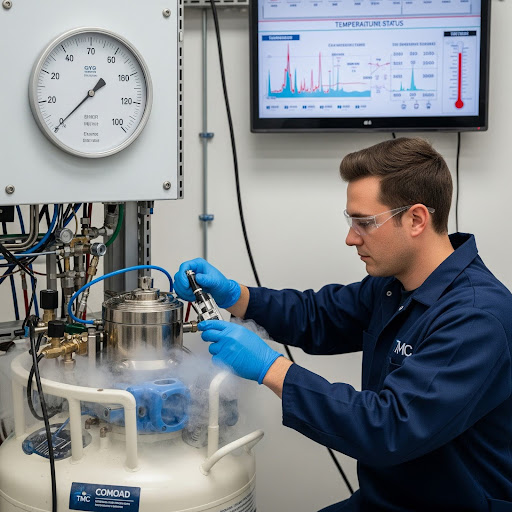
It’s a domino effect—one part failing to adapt puts the whole system at risk.
Real-World Impact: What One Missed Maintenance Call Cost a Client
Last winter, a mid-sized imaging center in the Midwest delayed their seasonal maintenance. They’d never had an issue before. But when temperatures plummeted in January, their water chiller couldn’t regulate the temperature fast enough. Compressor efficiency dropped, the cold head started to underperform, and helium levels plummeted by 20% in just five days.
The result? Emergency service, an unexpected helium fill, and three days of lost scanning capacity.They’ve since partnered with TMC for proactive seasonal maintenance—and haven’t had an issue since.
Proactive Seasonal Maintenance
We’re not the hero—you are. Your team keeps patients cared for, diagnoses delivered, and operations humming. But when temperature extremes threaten your equipment’s reliability, that’s where we step in.
3-Step Plan to Cold Season Confidence:
- Schedule a Seasonal Evaluation
We assess your cryosystem’s readiness for temperature changes. - Implement Preventative Measures
From optimizing water chiller settings to inspecting compressors and cold heads, we prepare your system for the environmental shift. - Monitor and Maintain
With ongoing service and remote monitoring, you stay ahead of performance dips and costly surprises.
Why This Matters—Now More Than Ever
Environmental conditions aren’t getting more predictable. As seasons become more extreme, systems that once “got by” without regular adjustment are beginning to fail more often. Proactive care isn’t a luxury—it’s a necessity.